Resilience and Riding
An article by Charley Baillie, Head of Co-Curricular and Riding
It didn’t go to plan round the last set of show jumps you attempted and now you have to go round the course again. Worry sits heavy in your tummy, but you give the pony you are sitting on a squeeze – “Let’s go, please look after me,” you think. The next thing you know, you’ve made it round, finishing to rapturous applause from your peers watching on. You sit a little bit taller, breathe a little more softly, you did it!
That sense of worry and dread brings a huge learning opportunity with it. If you can push past it, you learn something about yourself, showing your doubting mind that you can achieve things you felt were too hard. Resilience isn’t something we are born with; it is learned through failing, getting back up and trying again – and horses are among the very best teachers of this.
“Riding supports more than just physical development of children. Of course it helps with coordination and balance, but it also develops a sense of pride and achievement.”
Those feelings rarely come from everything going perfectly; they come from the moments when things don’t go to plan, whether that is a stumble from the horse, an unexpected spook or meeting a jump at the wrong time and feeling like you’ve only just survived – and you choose to try again anyway.
Over the years I have been Head of Riding at Hanford Prep I have seen firsthand how it can take a great deal of courage to get on a pony after a difficult ride. The height feels greater, the uncertainty sharper, and the “what ifs” louder. Yet each time a child swings their leg back over the saddle, they are proving something important to themselves: that fear doesn’t have to be the thing that decides what happens next.
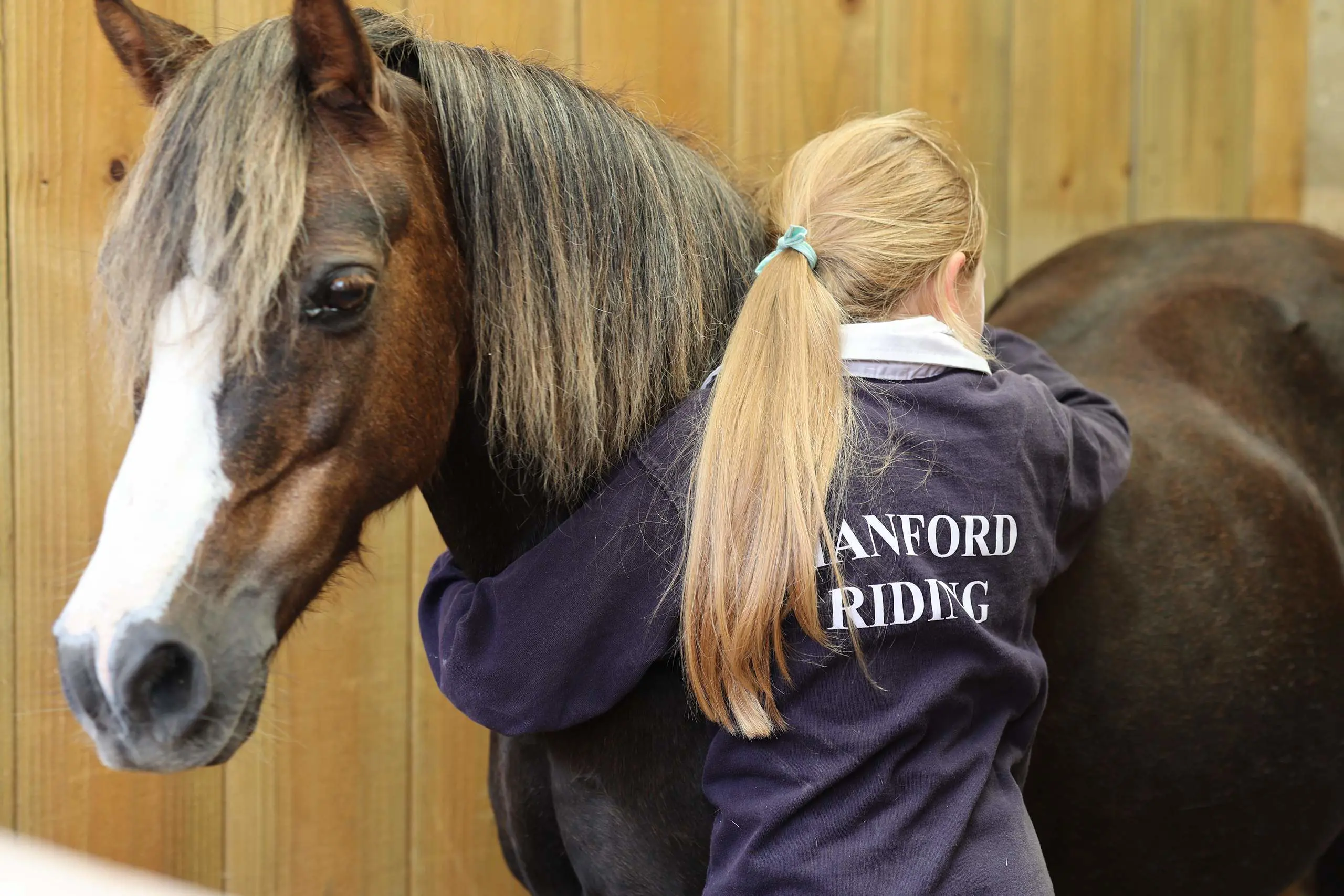
Horses, with their sensitivity and honesty, mirror emotions. They respond to tension, reward calmness, and thrive on trust. This makes them powerful partners in building resilience. The girls at Hanford Prep learn that frustration rarely helps, but patience, consistency, and quiet determination do. Progress is sometimes slow, and sometimes it feels like two steps forward and one step back, but that journey is where resilience grows strongest.
There is also a quiet discipline in riding that often goes unnoticed. Long before tackling a round of show jumps or a first gallop up Hambledon hill, resilience is built in the early mornings when girls get up to catch ponies in from the muddy fields before breakfast, with cold fingers fastening buckles on headcollars, in trying to keep hold of your wellies in the sticky mud. It is the daily grooming of horses, thinking about keeping your heels down each stride you take when you’re riding, and in listening carefully to feedback, even when it’s not what you hoped to hear.
“Setbacks in riding can feel deeply personal. When a round goes wrong or a lesson feels difficult, it is easy to feel you've failed. But horses are great at helping children to learn, patiently letting them try again, slow down and grow more confident as they find their own way, at their own speed. In this way, challenges are no longer something to avoid, but something to learn from."
Horses have off days, riders have off days, and sometimes things simply don’t come together. Learning to accept this without losing motivation is a skill in itself. It encourages riders to be kind to themselves, to recognise effort as well as outcome, and to come back the next day ready to try again. It is all too easy to focus on what could be done better, but it is more important to learn to see the positives, to look at your ride and find what made you proud. It is not always easy to be proud of the small achievements, but these are what build resilience over time.
And perhaps most importantly, riding fosters a sense of independence. Riders learn to take responsibility - for their preparation, their mindset, and their progress. They learn that while support from the stables team and friends is valuable, the decision to keep going ultimately comes from within.
For children, these lessons reach far beyond Handford’s indoor arena or wherever they are riding. The ability to cope with setbacks, to manage nerves, and to keep going when something feels difficult are skills that shape how they approach school, friendships, and life’s wider challenges. The applause at the end of a round is wonderful, but it is the inner voice that says “I did it” that matters most.
Resilience in riding isn’t about never feeling afraid or never making mistakes. It’s about what you do next. It’s about taking a breath, steadying your hands, giving your pony a reassuring pat, and choosing to go again. And in those moments - quiet, determined, and often unseen - riders discover a strength that will stay with them long after they leave the saddle.
Where Next?